
Sewing Training That Turns Textile Waste into Opportunity
At Upcycle, sewing is more than a technical skill. It becomes a practical pathway to transform textile waste into usable products, income opportunities, and long-term capability. This training is intentionally structured to move beyond theory, focusing instead on hands-on production, repetition, and measurable progress.
Building Skills That Translate into Real Value
From the outset, the training centres on core sewing competencies that are directly applicable in a production environment. In addition, the programme includes focused pathways such as a bag-making sewing course and an upcycled clothing stream, where participants learn to transform discarded garments into new, wearable products. They start with foundational techniques such as unpicking, hand stitching, and machine control. From there, they progress into straight stitching, zips, hems, folds, and topstitching. As skills develop, so does precision. Every exercise is designed to build consistency, because consistency is what turns a skill into something market-ready. At the same time, the materials used are not new. Instead, the training integrates textile waste, offcuts, discarded fabrics, and post-consumer materials, into every stage of learning. As a result, participants gain experience working with real-world inputs while actively contributing to waste diversion.
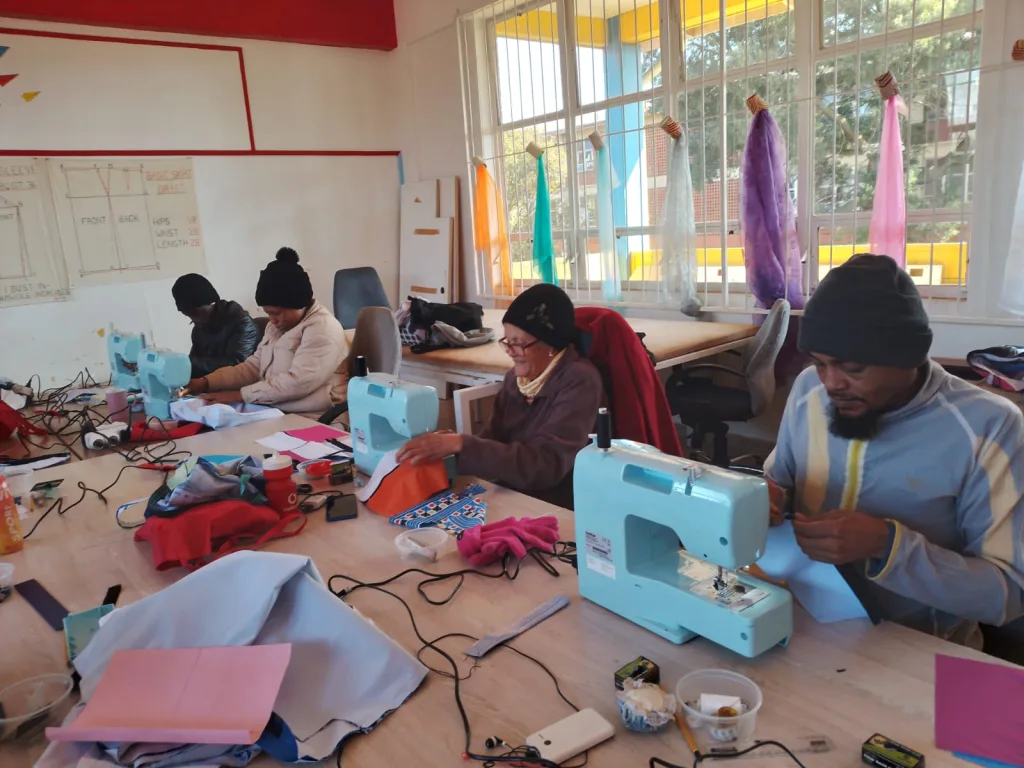
This approach ensures that learning remains relevant, resource-efficient, and environmentally responsible.
Learning Through Repetition and Production
Progress within the programme is driven by doing. We make a vast range or products so the skill is repeated multiple times until the learner can reproduce it with accuracy and confidence.
Typically, participants must complete a series of the same item before it reaches a standard suitable for quality control. This process is deliberate. Repetition builds muscle memory, sharpens attention to detail, and reinforces production discipline.
As learners improve, their work begins to meet the requirements for saleable products. At this point, training and production start to intersect. Items that meet quality standards can move into stock or fulfil real orders, introducing learners to the expectations of a working production environment.
This is where skills begin to translate into tangible economic value.
Advancing from Training to Production Readiness
Not all progress is time-based. Instead, advancement is earned through demonstrated ability.
As participants develop, trainers assess not only technical skill but also reliability, consistency, and attention to detail. Those who show readiness move into more advanced production-focused sessions.
In this phase, the focus shifts. Learners refine their work to meet the standards required for larger-scale production, including items used in Upcycle’s corporate product lines. Precision, speed, and repeatability become critical.
Because of this, participants begin to operate within real production conditions. They learn how to meet briefs, maintain quality across multiple units, and deliver work that can confidently enter the market.
Textile Waste Diversion as a Practical Outcome
While skills development remains central, environmental impact is built into the process.
By using textile waste as the primary input material, the training actively diverts usable fabric from landfill. More importantly, it demonstrates how waste can become a reliable resource within a circular system.
Participants leave with more than sewing ability. They gain the capacity to identify, source, and transform discarded textiles into products with value. This shift in perspective is critical. It enables ongoing production beyond the training environment, using materials that are locally available and often overlooked.
A Structured Pathway to Capability
The programme is designed to remain accessible at the entry level while maintaining clear standards for progression.
Everyone starts with the same opportunity to learn. However, movement into higher-value production work depends on effort, consistency, and output quality. This creates a system that is both inclusive and performance-driven.
At the same time, the structure reflects real-world conditions. Production opportunities are not assumed, they are earned through readiness. This ensures that when participants step into income-generating work, they are equipped to deliver at the required level.
From Waste to Work
Ultimately, this sewing training creates a direct link between material recovery and economic opportunity.
Textile waste becomes the starting point. Through structured learning and repeated practice, it is transformed into finished products. In parallel, participants develop the skills needed to participate in a circular economy, where waste is no longer discarded, but continuously reimagined as a resource.
This is how sewing becomes more than a skill. It becomes a system for creating value, reducing waste, and building sustainable livelihoods.
can you add in that we run a bag making sewing corse and an upcycle clothing from clothing waste
you can follow us on facebook for more up to date content